
|
|
 |
|
|
 |
 |
| |
|
|
Typical 3-Channel CMT
Installation in Overburden
with Bentonite and Sand
Cartridges |
|
Typical 3 or 7-Channel CMT
Installation using Layers of
Bentonite and Sand
Backfilled from Surface |
|
|
|
|
A multilevel well that uses a continuous length of multichannel tubing has the advantage over other multilevels in that there are no joints. This significantly reduces the time and cost of installing wells and at the same time increases the reliability of the system. The CMT is very simple and convenient to use, as it gives full flexibility as to where monitoring zones are located.
The number and location of ports may be determined in advance, or after drilling the borehole. A Port Cutting Guide is used to create a port in a given channel, at the specified depth to be monitored. A plug is positioned and sealed in the channel just below the port opening and a stainless steel screen is fixed in place over the port to prevent fines from entering. Each channel is also sealed at the bottom of the tubing to avoid cross communication between monitoring zones.
|
|
|
|
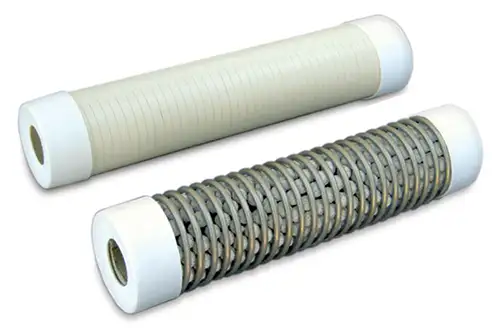
For direct push installation of the 3-Channel System, the annulus available is often too small to accurately place sand and bentonite layers. Therefore, bentonite cartridges have been developed to give reliable seals between zones, and accompanying sand cartridges to complete the installation.
These cartridges are approximately 2.4" (61 mm) in diameter and will fit inside various direct push drill rods. Ideally, the borehole diameter these bentonite cartridges are used in should not exceed a nominal 3.5" (90 mm), to ensure proper expansion and sealing.
|
|
|
| |
|
| |
|
|