
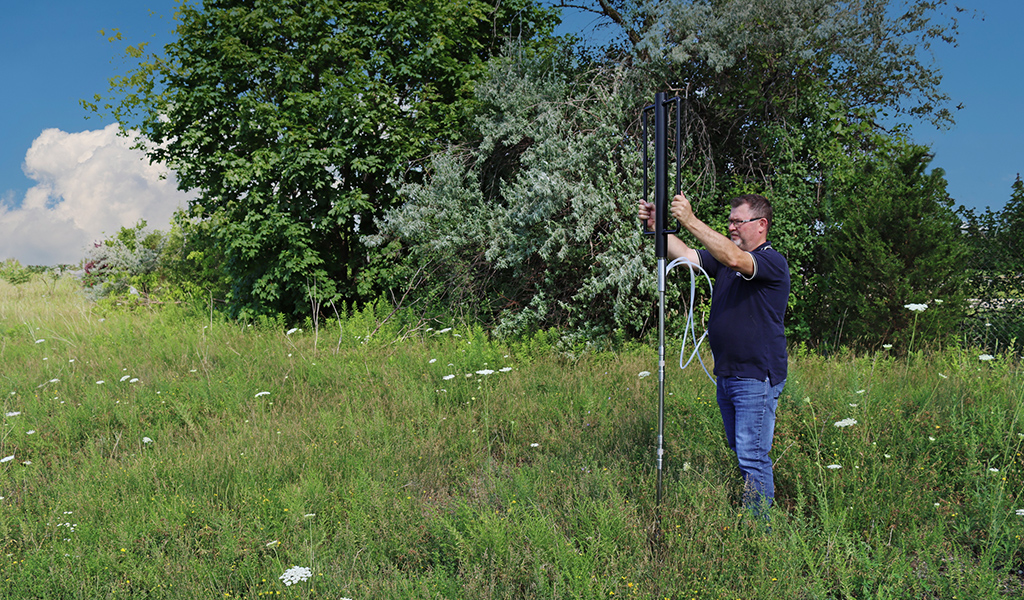
- Ideal for initial site investigations
- High quality stainless steel piezometer tip
- Completes a simple, very cost effective well
- Drives 20 to 25 ft in suitable soils


615N Simple Well Point
- Water Level Monitoring and Groundwater Sampling
 615 Barbed Fitting; 1/2" ID Tubing to Surface
- Narrow dia. water level monitoring
- High groundwater sample integrity
 615C Compression Fitting; 1/4" OD Tubing to Surface
- Vapor / soil gas monitoring
615S or SN Shielded Drive-Point
- Avoid smearing and plugging of the screen during installation
 615ML Multilevel System
- High resolution vertical groundwater and soil gas profiling
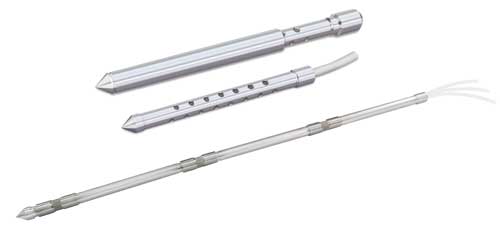
The Model 615 Drive-Point Piezometers use a high quality stainless steel piezometer tip, 3/4" NPT pipe for drive extensions and LDPE or PTFE sample tubing, if desired. Combine these with an inexpensive Slide Hammer and you have a complete system.
The Model 615ML Multilevel Drive-Point System allows monitoring of up to 6 zones in one drive. The Drive-Point Ports have a dual barb stem to attach either ¼" OD or ⅜" OD tubing. The Multilevel Drive-Point Piezometer can be installed using extensions and a Manual Slide Hammer, similar to standard 615 installations.
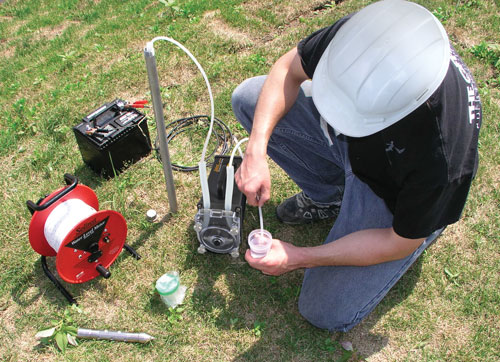
Photo above shows the installation of a 615 Drive-Point Piezometer being used for water level measurement with a 101 Water Level Meter and groundwater sampling with a 410 Peristaltic Pump.
The 410 Peristaltic Pump is ideal for sampling groundwater and vapor in shallow piezometer applications. Connect a 12V Battery Holder to create a very portable assembly.
Learn more on getting high-quality groundwater samples with your Drive-Point Piezometer and Peristaltic Pump in our technical bulletin.
Low Cost Standpipe Piezometers
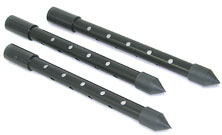
- Reliable
- Low cost
- Excellent for water level, metals sampling
- How to use a Standpipe Piezometer
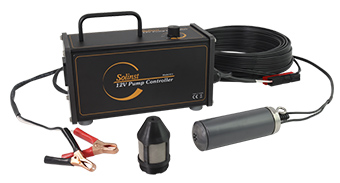
415 12V Submersible Pump
The Solinst 12V Submersible Pump provides an efficient means of purging and obtaining groundwater samples from 2" OD monitoring wells. The compact pump can sample from depths of 36.5 m (120 ft) below ground surface, and is easy to adjust the flow rates up to 13.5 L/min (3.6 US gpm) in shallower applications.

Make Your Life Easier In The Field
Consider making your life easier in the field by ordering one of our convenient Field Tables. We have two models available, Well-mount and Stand-alone, to keep your equipment organized and provide a clean, sturdy surface to hold your field tools.
Well-mount Field Table - 115209
Stand-alone Field Table - 115312