
Pump/Recharge Rate Affects Saltwater Intrusion
Groundwater management, monitoring and conservation
keep intrusion under control.
Almost two thirds of the world's population lives within 400 km (250 miles) of the ocean shoreline; just over half live within 200 km (125 miles), an area only taking up 10% of the earth's surface. Most of these coastal regions rely on groundwater as their main source of fresh water for drinking, industry, and agricultural purposes. As the world's population continues to grow at an alarming rate, fresh water supplies are constantly being depleted, bringing with it issues such as saltwater intrusion and increasing the importance of groundwater monitoring and management.
Saltwater intrusion is a major concern commonly found in coastal aquifers around the world. Saltwater intrusion is the induced flow of seawater into freshwater aquifers caused by groundwater development near the coast. Where groundwater is being pumped from aquifers that are in hydraulic connection with the sea, induced gradients may cause the migration of salt water from the sea toward a well.
The key to controlling saltwater intrusion is to maintain the proper balance between water being pumped from the aquifer and the amount of water recharging it. Constant monitoring of the salt-water interface is necessary in determining the proper management technique.
The Ghyben-Herzberg Relation
Fresh water is less dense than salt water, therefore it floats on top. The boundary between salt water and fresh water is not distinct, the transition zone or interface is brackish with salt water and fresh water mixing.
Under hydrostatic conditions, the weight of a unit column of freshwater extending from the water table to the salt-water interface is balanced by a unit column of salt water extending from sea level to that same point on the interface. Also, for every foot of groundwater above sea level there are forty feet of fresh water below sea level.

X Groundwater Level Y Sea Water Level
Salt-water interface in an unconfined coastal aquifer according
to the Ghyben-Herzberg relation.
This analysis assumes hydrostatic conditions in a homogeneous, unconfined coastal aquifer. According to this relation, if the water table in an unconfined coastal aquifer is lowered by 1 m, the salt-water interface will rise 40 m.
China's Imbalance
Since the early 1960's, the coastal aquifers of China have been studied for saltwater intrusion. With a transition zone of 1.5 to 6.0 km, and an aquifer area of more than 580 km2, the increasing extension of saltwater intrusion is a major concern in this area.
A study conducted in the City of Laizou in 1971, and in the City of Longkou in 1979, illustrated that excessive pumping of the groundwater in these areas had caused saltwater intrusion. In the beginning, the observations were taken from specific, isolated spots (0.5 km2). Over time, the intrusion area spread as increases in water taking for agricultural and industrial purposes persisted. In 1979, the saltwater intrusion area covered 16 km2, 39 km2 in 1982, 71 km2 in 1984, and 196 km2 in 1987. By 1989, the saltwater intrusion area became a continuous zone covering an area of 238 km2 in Laizhou. In the 1970's, the saltwater intrusion area in the southwestern part of the study area increased by 4km2 each year. In the early 1980's, this number increased to 11.1 km2, and after the mid-1980's to 30 km2. This rapid increase reinforces the need for proper monitoring and controlling methods for saltwater intrusion.
Methods and Instrumentation used for Investigation
Late in the 1960's, efforts rose toward drilling for chemical analysis of groundwater samples and the determination of flow patterns based on piezometric levels. Geophysical methods of investigation were introduced later, and were found to provide more information faster than the drilling techniques. Subsequently, geophysical methods became more important for saltwater intrusion monitoring.
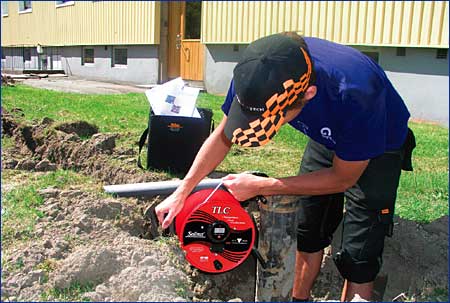
Field technician measures water level elevations determining the potentiometric surface of an aquifer.
Today, there are numerous methods available including: well logging, chemical analysis of groundwater samples, classification of groundwater samples, research into the interaction between aquifer matrix and groundwater, and most common, chloride concentration profiling, and vertical conductivity and temperature profiling.
Conductivity and Temperature used to Estimate Salinity.
An aqueous solution's ability to carry an electrical current by means of ionic motion is measured through conductivity. Salinity is the measured mass of dissolved salts (ions) in a solution. As such, conductivity readings provide a good indication of salinity. Conductivity is interdependent with temperature, therefore profiling both of these variables becomes an important factor when determining the behavior of the transition zone and the salt-water interface.
Through using devices such as the Solinst Model 107 TLC Meter (Temperature, Level, Conductivity), salinity can be estimated through conductivity and temperature readings, both taken at a discrete depth. The TLC Meter features a 'smart' probe that provides accurate temperature and conductivity measurements, and is attached to high quality flat tape for depth readings. The probe and tape are mounted on a sturdy reel making operation easy. Instruments such as this make vertical temperature and conductivity profiling simple.
For example, a conductivity reading of 25,000 µS/cm and a temperature reading of 20°C yield a salinity estimation of 17ppt. Through this method of investigation, borehole profiles of salinity can be used to track the fluctuation of the salt-water interface. This, in turn increases the potential to control saltwater intrusion problems.
Control of Salt-Water Intrusion
The increased use of groundwater has caused the salt-water interface to move inland and closer to the ground surface along much of the Atlantic Coast of the United States, as well as Southern California. In the past, many communities in these areas who came across a saltwater intrusion problem simply set up new production wells further inland. This only complicated the issue. Since then, efforts to maintain groundwater levels by ponding surface water runoff or using river water to recharge the groundwater table have been successfully implemented.
Deep recharge well creates groundwater ridge.
Other methods to control saltwater intrusion, such as using deep recharge wells, have also been successful. These wells create a high potentiometric surface, which allows for the pumping of groundwater below sea level landward of a groundwater ridge created.
Potentiometric surface mapping of an aquifer can provide important information determining the direction of groundwater flow within a confined aquifer. Plotting water level elevations on a map and contouring the results determines this. The contoured surface is known as the potentiometric surface, which is actually a map of the hydraulic head in the aquifer. In some instances, barrier wells have been set up near the shore to pump out salt water and recharge a fresh water gradient toward the sea.
Recharge wells, recharge basins and barrier wells have proven to be very useful in maintaining the proper equilibrium between pumping and groundwater recharge. Therefore, proper groundwater monitoring techniques and groundwater management, combined with groundwater conservation are needed to keep saltwater intrusion under control.
References:
Hinrichsen, Don. 2007. Ocean Planet in Decline. Available: [online] http://www.peopleandplanet.net/pdoc.php?id=429. Accessed: November 7, 2007.
Elizabeth R. McNew, Sara Arav. 1995. Ground Water: Surface Geophysical Surveys of the Freshwater - Saltwater Interface in a Coastal Area of Long Island, New York. v 33 #4, pp 615-626.
Yuqun Xue, Jichun Wu, Peimin Liu, Jianji Wang, Qingbo Jiang, and Hongwen Shi. 1993. Ground Water: A Study on Sea-Water Intrusion in the Coastal Area of Laizhou Bay, China: Distribution of Sea-Water Intrusion and Its Hydrochemical Characteristics. v 31, Number 4, pp. 532 to 537.
R. Allan Freeze, John A. Cherry. 1979. Groundwater: Groundwater Source Evaluation. Prentice-Hall, Englewood Cliffs, New Jersey, pp.375-378.
W. De Breuck. 1991. Hydrogeology of Salt-Water Intrusion: Methods and Instruments. Verlag Heinz Heise GmbH & Co KG, Hannover, Germany, pp 223.
Fletcher G. Driscoll. 1986. Groundwater and Wells: Control of Salt-Water Intrusion. Johnson Division, St. Paul, Minnesota pp 773.
Author:
Jason G. Redwood is the Marketing Manager at Solinst Canada Ltd., a manufacturer and international supplier of ground water monitoring instrumentation in Georgetown, Ontario, Canada
|