
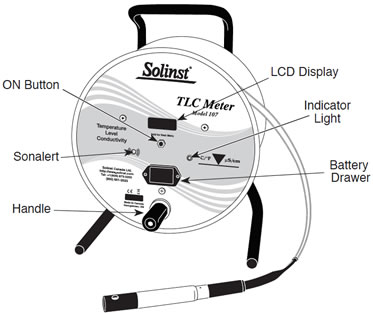
Front View
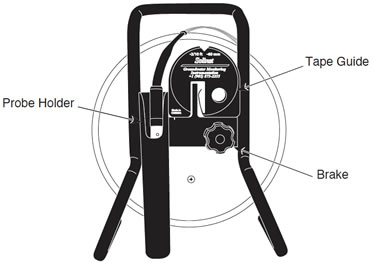
Back View
The Solinst Model 107 TLC Meter measures temperature, level and conductivity. Temperature and conductivity readings are displayed on the LCD screen and water level is read from the tape as with a conventional Water Level Meter. When the probe is immersed in a conductive fluid, a circuit is completed and the water level is indicated by a tone and light that lasts about 1 second.
Conductivity measurements are read from 0 to 80,000 μS/cm with readings giving accuracy of 5% of reading or 100 μS (which ever is greater). The 'smart probe' displays conductivity which has been standardized to 25°C, i.e. Specific Conductance (displayed as EC). The conductance Temperature Coefficient is 2.0% per ºC. Temperature accuracy is ±0.2ºC from -15°C to +50°C.
Note:
When reading conductivity on the display, e.g. "0500μ" = 500 μS/cm. When conductivity reaches 10,000 μS/cm, the display will show "10.0M" (M = millisiemens). E.g. 13,470 μS/cm will display as 13.5M.
Equipment Check
Upon receipt of your Solinst Model 107 TLC Meter, and always before heading out to the field, the following checks are recommended:
- Turn the meter on. The display should show "EC 0000μ" and air temperature (e.g. 21.1ºC). If the battery is low, a 'LOW BATT' warning appears and the 9 volt alkaline battery should be replaced. If "No Comm" appears, check the probe connection to the tape (call Solinst if message persists). If the display is blank, install a new 9V battery.
- Ensure the probe tip and shroud are clean.
- Test probe in fresh calibration solution close to the range you expect to measure in the field. Allow suitable time for equilibration. If readings are not within an acceptable range, conduct a user calibration. (See Calibration Instructions).