
8700 CyanoFluor | Cyanobacteria Monitoring

Solinst Water Technologies, LLC
(Formerly Turner Designs)
1995 N 1st Street, San Jose, CA 95112, United States
Tel: +1 877-316-8049
Tel: +1 408-749-0994
email: [email protected]
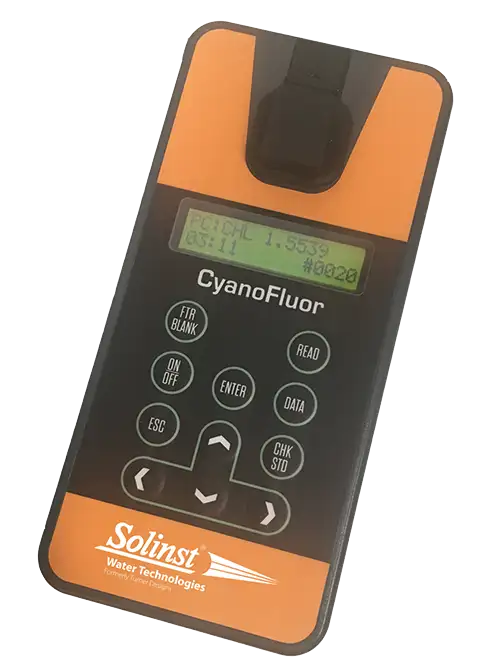
CyanoFluor Model 8700 – Handheld Fluorometer for Cyanobacteria Monitoring
Recognise Changing Algal Conditions. Make More Informed Water Quality Decisions.
Harmful algal blooms (HABs) can create significant challenges for drinking water supplies, recreational waters, aquaculture operations, and aquatic ecosystems. Understanding when conditions are changing is an important part of protecting water resources and planning effective monitoring programmes.
The Solinst Water Technologies CyanoFluor Model 8700 is a portable, active fluorometer designed to help environmental professionals identify changes in cyanobacteria-related fluorescence within mixed algal populations.
By measuring phycocyanin (PC) and chlorophyll (CHL) fluorescence and automatically calculating their ratio, CyanoFluor provides additional insight into changes in algal community composition.
With results available in less than 30 seconds, CyanoFluor helps users make informed decisions about field monitoring, follow-up sampling, and laboratory investigations.
Look Beyond Algal Abundance to Understand What Is Changing
Not all algae present the same environmental concerns.
Aquatic systems contain diverse algal communities, and the abundance and composition of these communities can change in response to seasonal conditions, nutrient availability, light, temperature, and other environmental influences.
Monitoring chlorophyll fluorescence provides useful information about photosynthetic organisms in water. However, chlorophyll measurements alone cannot distinguish cyanobacteria from other algae.
Phycocyanin fluorescence adds another measurement associated with cyanobacteria, helping researchers and water resource managers understand changes within mixed algal populations.
CyanoFluor brings these measurements together by automatically calculating the phycocyanin-to-chlorophyll fluorescence ratio.
Understanding how this ratio changes over time can provide an early indication of increasing cyanobacterial dominance and help identify conditions that warrant closer investigation.
Rather than relying on a single fluorescence measurement, users gain additional context about the biological changes taking place in the water.
Why the Phycocyanin-to-Chlorophyll Ratio Matters
A rise in phycocyanin fluorescence does not necessarily mean that cyanobacteria are becoming more dominant within an algal population.
The increase could reflect broader growth in the overall algal community.
By evaluating phycocyanin and chlorophyll fluorescence together, the CyanoFluor provides a more informative way to examine changes in relative pigment signals.
Phycocyanin (PC)
Phycocyanin is a fluorescent pigment commonly associated with cyanobacteria. Measuring its fluorescence can help track changes in cyanobacteria-related signals in aquatic environments.
Chlorophyll (CHL)
Chlorophyll fluorescence provides information associated with photosynthetic organisms, offering a broader perspective on the algal population.
PC:CHL Ratio
The relationship between these two fluorescence measurements can reveal changes in the relative contribution of cyanobacteria-associated fluorescence within a mixed algal community.
Tracking this relationship over time may help identify developing conditions associated with harmful algal bloom activity.
The key is understanding the relationship between measurements, not simply collecting more individual readings.
Support Earlier Investigation of Harmful Algal Bloom Conditions
Harmful algal blooms can develop as environmental conditions become favourable for cyanobacterial growth.
By the time a bloom becomes visually apparent, changes in the aquatic environment may already have been occurring for some time.
Regular fluorescence monitoring provides an opportunity to observe biological indicators before obvious surface accumulations develop.
CyanoFluor helps users establish a record of phycocyanin and chlorophyll fluorescence measurements and examine how their relationship changes across sampling locations and monitoring periods.
These observations can support:
- Identification of unusual changes in cyanobacteria-related fluorescence
- Recognition of trends that may warrant increased sampling frequency
- Prioritisation of locations for additional water quality investigations
- Improved planning for laboratory analysis
- Documentation of changing conditions throughout the monitoring season
CyanoFluor is a screening and monitoring instrument. Fluorescence measurements do not directly establish cyanotoxin concentrations, confirm toxicity, or independently predict whether a harmful bloom will occur.
Instead, they provide valuable field information that can complement established monitoring protocols and confirmatory laboratory testing.
Rapid Field Measurements Where Water Quality Decisions Are Made
Environmental monitoring often involves multiple sampling locations, changing field conditions, and limited time available for collecting data.
CyanoFluor is designed to simplify the collection of fluorescence measurements in these environments.
The handheld instrument analyses raw water samples using a straightforward cuvette-based measurement process.
Insert the sample, initiate the measurement, and review the results directly on the instrument.
With results displayed in less than 30 seconds, field personnel can collect measurements efficiently while moving between sampling locations.
Simplify Routine Field Monitoring
Collect rapid fluorescence measurements without transporting every sample to a laboratory for initial screening.
Compare Conditions Across Locations
Measure samples collected from different areas of a lake, reservoir, or water body to examine variations in pigment fluorescence.
Establish Historical Monitoring Records
Store measurements for later review, helping document changes throughout the monitoring period.
Support Timely Follow-Up
Use unexpected changes or developing trends to inform decisions about additional sampling, laboratory testing, and monitoring priorities.
The result is a practical field measurement tool that helps connect water quality observations with the decisions required to manage monitoring programmes.
Applications for CyanoFluor Monitoring
Drinking Water Source Protection
Lakes and reservoirs used for drinking water supply require ongoing assessment of biological conditions.
CyanoFluor can support source-water monitoring programmes by providing rapid measurements of cyanobacteria-associated and chlorophyll fluorescence.
Monitoring changes in PC ratios may help water quality teams identify conditions that warrant closer examination, additional sampling, or confirmatory testing.
Recreational Water Monitoring
Beaches, lakes, and other recreational waters can experience changing algal conditions during warmer months.
Portable fluorescence measurements provide an additional screening tool for monitoring cyanobacteria-related changes throughout the season.
CyanoFluor can complement visual observations, water quality sampling, and established public health monitoring procedures.
Lake and Reservoir Research
Understanding the seasonal development of algal populations is important for aquatic ecosystem research.
CyanoFluor allows researchers to collect pigment fluorescence measurements from multiple sampling locations and compare changes over time.
These observations can contribute to investigations involving nutrient dynamics, environmental conditions, and changes in algal community composition.
Aquaculture Monitoring
Algal community changes can influence water quality conditions in aquaculture environments.
Regular monitoring of chlorophyll and phycocyanin fluorescence can provide additional information about biological activity and changes in cyanobacteria-related signals.
CyanoFluor supports targeted field investigations that complement other water quality measurements used in aquaculture management.
Watershed and Environmental Monitoring
Runoff, nutrient inputs, changing water levels, and seasonal conditions can influence aquatic biological activity.
CyanoFluor can be incorporated into broader watershed monitoring programmes to investigate changes in fluorescence measurements across different sampling locations and environmental conditions.


