
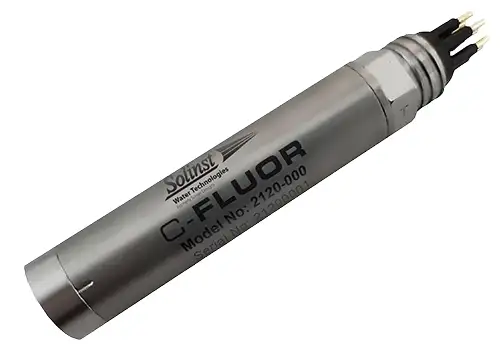
Model 2120 C-Fluor Submersible Fluorometer

Solinst Water Technologies, LLC
(Formerly Turner Designs)
1995 N 1st Street, San Jose, CA 95112, United States
Tel: +1 877-316-8049
Tel: +1 408-749-0994
email: [email protected]
C-Fluor Submersible Fluorometers
Targeted Optical Measurements. Greater Environmental Understanding.
Understanding water quality often requires looking beyond traditional monitoring parameters. Changes in dissolved organic matter, biological activity, fluorescent tracers, and other substances can provide valuable insight into the movement and condition of water.
The Solinst Water Technologies C-Fluor Model 2120 is a compact, submersible fluorescence sensor designed to bring targeted optical measurements directly into the field.
Available in application-specific configurations, C-Fluor supports continuous monitoring, research, and integration into existing data collection systems. Whether investigating groundwater movement, studying aquatic ecosystems, or tracking changes in water quality, C-Fluor helps researchers and environmental professionals collect meaningful fluorescence measurements where they matter.
See Beyond Conventional Water Quality Measurements
Water systems are constantly changing. Rainfall, runoff, biological processes, groundwater contributions, and human activities can influence water quality over time.
Conventional measurements such as temperature, conductivity, dissolved oxygen, and turbidity provide essential information. Fluorescence adds another perspective by detecting light emitted from specific substances when exposed to selected wavelengths of excitation light.
This makes fluorescence particularly valuable for investigating changes that may not be fully explained by conventional parameters alone.
By integrating targeted fluorescence measurements into environmental monitoring programmes, users can better understand:
- The movement and dispersion of fluorescent tracers through water systems
- Changes in dissolved organic matter and potential source-water influences
- Variations in algal pigment fluorescence associated with biological activity
- Fluorescence patterns relevant to wastewater and hydrocarbon investigations
- How environmental conditions change between routine sampling events
C-Fluor provides the optical measurement component needed to investigate these processes through individual observations or ongoing monitoring.
Select the Fluorescence Measurement That Matches Your Application
Not every fluorescence measurement answers the same question.
C-Fluor probes are available with different optical configurations, allowing monitoring programmes to target particular fluorescent substances or parameters.
Chlorophyll and Algal Monitoring
Changes in chlorophyll fluorescence can help identify patterns in algal activity and support investigations into aquatic ecosystem conditions.
C-Fluor chlorophyll configurations provide measurements that can complement temperature, turbidity, dissolved oxygen, and other water quality parameters.
Blue and red excitation options are available, including red excitation for applications involving CDOM-rich water.
Applications:
- Lake monitoring, aquaculture
- Environmental research
- Aquatic ecosystem investigations
Cyanobacteria Pigment Monitoring
Phycocyanin and phycoerythrin fluorescence provide additional information about pigments associated with cyanobacteria and other pigment-containing organisms.
Monitoring these fluorescence signals can help characterise changes in aquatic environments and identify conditions that warrant closer investigation.
Applications:
- Reservoir monitoring
- Cyanobacteria research
- Surface water assessment
- Aquatic ecosystem studies
CDOM and FDOM Monitoring
Colored dissolved organic matter and fluorescent dissolved organic matter measurements can provide useful information about the optical characteristics of water and changes in organic matter sources.
FDOM monitoring can support studies of runoff, watershed processes, groundwater–surface water interactions, and changing water quality conditions.
When combined with other monitoring parameters, fluorescence trends can help distinguish environmental changes that might otherwise be difficult to interpret.
Applications
- Watershed research
- Source-water investigations
- Groundwater studies
- Environmental monitoring
Fluorescent Dye Tracing
Fluorescent tracers are valuable tools for investigating how water moves through natural and engineered systems.
C-Fluor configurations for fluorescein and Rhodamine WT can support studies where detecting a tracer over time helps characterise transport pathways, travel times, and dispersion.
Applications:
- Groundwater tracing
- Stream studies
- Hydraulic investigations
- Water transport research
Hydrocarbon and Wastewater Investigations
Fluorescence measurements can also help investigate selected signals associated with hydrocarbons and wastewater-related substances.
C-Fluor configurations for crude oil, optical brighteners, and tryptophan provide targeted measurements for specialised environmental applications.
These measurements can support screening, trend identification, and decisions about where additional sampling or laboratory confirmation may be appropriate.
Applications:
- Environmental site investigations
- Wastewater influence studies
- Hydrocarbon screening
- Water quality research


