
405 Water Flute FAQ: Frequently Asked Questions

Water Flute Frequently Asked Questions: FAQs
Are the number of ports (sampling intervals) limited by the hole diameter?
Yes. The typical number of ports that can be installed in a liner are 6, 10, 15, and 20 in hole diameters of 4 inch, 5 inch, 6 inch, and 8 inch respectively.
Does it make any difference if the casing is a “stick up” above the surface or in a vault?
No, we often install in subsurface vaults. The vault dimensions required are at “Water Flute vault size.”
Subsurface vault to accomodate the Water Flute surface hardware
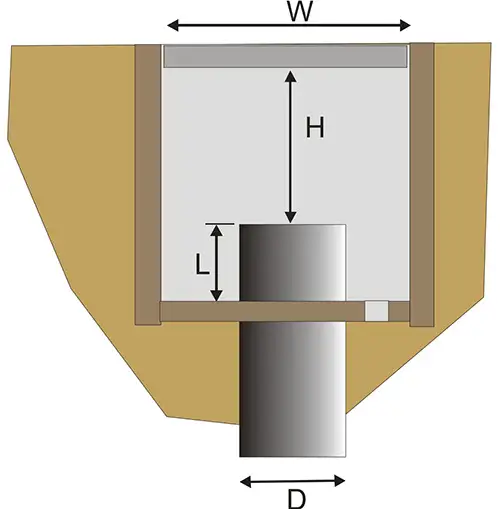
Minimum dimension of vault:
- D - diameter of the casing
- W - the inside vault width (D + 8 inches)
- L - the stick up of casing above vault floor (minimum 6 inches)
- H - the clearance from casing to underside of vault lide (12 inches)
These are preferred clearances for the 405 Water Flute system. A blank liner requires a Height of at least 4 inches. A drain in the floor of the vault is recommended to prevent water accumulation.
Note: Over 6 transducer calbes requires W = D + 12 inches
What is the “trio”?
The trio is the combination of:
- the sealing the hole with a blank liner,
- measuring the flow paths in the entire hole while installing the blank liner, and
- the subsequent installation of a Water Flute multi-level system in place of the blank liner.
Are Water Flutes only temporary sampling systems and how long do they last?
The majority of the Water Flute systems installed are still in use. –some more than 18 years.
Can a Water Flute system be installed in an unstable hole (e.g., sediments)?
Yes The installation is often in a multi screened casing. However, installations through sonic casing have also been done.
How deep can a Water Flute be installed?
To date, our systems have been installed in boreholes as deep at 1400 FT.
Why is a Water Flute different from other multi-level systems?
- the liner seals the entire hole instead of discrete packers or grout.
- the liner is only 20 mils and therefore the entire hole volume is available for the sampling system with its unique characteristics
- the eversion installation procedure is gentle, supporting of the borehole, and allows removal by inversion of the liner. Those are the primary differences, but there are many more differences depending upon which systems are being compared.
Can one use transducers with a Water Flute for measuring the head history at the several ports?
The transducers are installed in the system and do not interfere with either the sampling procedure or the manual water level measurement for each port. Nor does the transducer use limit the number of ports available in a particular hole diameter.
Transducers can also be added at the surface to record long term head measurements using an Air Coupled Transducer (ACT) system.
Can one measure the head for each port as well as draw a sample?
Yes One can use a slender tag line to measure the head at each port or use a pressure transducer for each port, or both simultaneously, allowing a check of the transducer calibration.
Are the Water Flutes removable?
Yes It usually takes a day. Deep wells and many ports may take longer.
Can anyone install a Water Flute?
No Only Solinst Flute personnel should install or remove a Water Flute or those specifically trained by Solinst Flute.
How long does it take to install a Water Flute?
Typically one to two Water Flutes can be installed in a day. If a short scaffold is needed for a shallow water table and a weighted mud is to be emplaced, the installation may take two days.
Do drillers install Water Flutes?
No
What equipment is needed to install a Water Flute?
A compressor, generator and water tank are usually supplied by the customer unless near (<300 mi.) a Solinst Flute office. Solinst Flute offices are in Albuquerque, NM and Warminster, PA. For multiple installations, Solinst Flute may provide all of the equipment at normal rental rates. Any additional special equipment is provided as rented equipment and is sent to the site from Solinst Flute.
Is a driller required for a Water Flute installation?
Generally a driller’s services are not needed. However, in at least New Jersey, regulations require that a driller be present for a Water Flute installation.
Does Solinst Flute obtain well permits?
No Solinst Flute does not obtain well permits, variances or other regulatory documentation. That is usually done by a driller or environmental contractor.
Does the EPA approve of Water Flute use?
The EPA is a major customer of Water Flutes and other Solinst Flute technologies. Water Flutes are in place at many superfund sites.
Are there juried journal articles describing Water Flutes use?
Yes. See the GWMR journal paper on Water FLUTe use: A New-Depth Discrete Multilevel Monitoring Approach for Fractured Rock
Is Water Flute technology accepted by the regulators?
Yes The EPA, NJ DEP, and many other states have approved the use of Water Flute technology. Ask us for examples in your state.
Does Solinst Flute sell a lockable wellhead cover for the exposed surface casing?
Yes, it protects the entire Water Flute wellhead surface hardware and transducer cables.
What is the total cost of a Water Flute system?
Provide Solinst Flute with the site location, hole depths and diameters, number of ports for each hole, and water table (if known) and a detailed quote including labor, rental equipment, travel costs, shipping and Solinst Flute liners will be provided.
Can Water Flutes be installed in artesian wells?
Yes, if the artesian head is less than 5 ft above the ground surface. A weighted mud will be needed to obtain the liner pressure required to seal the hole.
How can the excess head required in a liner be obtained for a very shallow water table (less than 6 ft)?
A weighted mud (Bentonite and barite slurry) is used to displace the water in the liner, from the bottom up, inside the liner via a tube provided in the tubing bundle. The liner is still removable.
Does Solinst Flute select the sampling intervals based upon a Flute conductivity profile?
No, but the conductivity profile performed by Solinst Flute using the blank liner is sometimes the primary basis for selection of the sampling intervals for a Water Flute.
Are Water Flute samples acceptable to the regulators as quantitative assessments of water quality?
Yes
Are Solinst Flute systems warrantied?
- Yes
- Ask for this publication from [email protected].
- How do Water Flute systems compare to alternative methods? Call us for explicit questions. Also see comparisons for general guidelines in comparison of multi level systems.
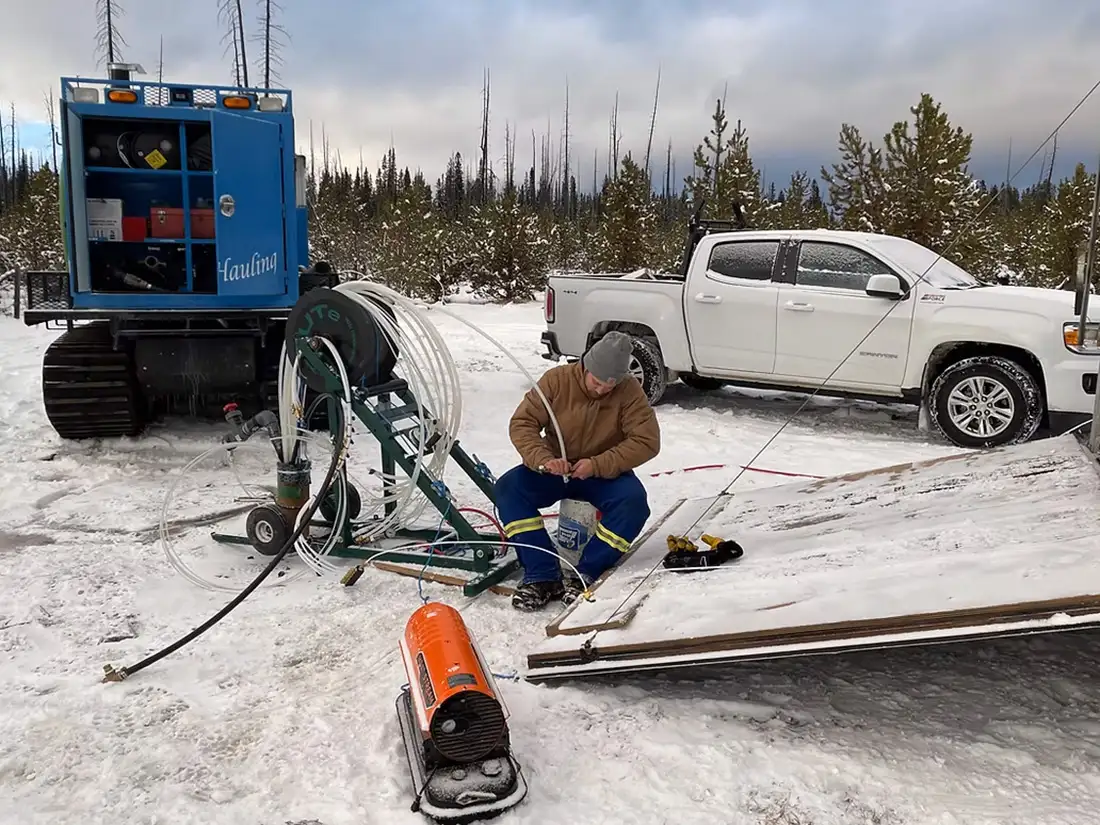
Can Water Flutes be installed in freezing conditions?
Yes They often are, but we prefer more mild weather.
Is there any other supplier of flexible liner systems?
No, Solinst Flute is the sole source and our methods are well patented, but we are interested in potential foreign fabrications sites and the licensing of installers.
How much does a Water Flute system cost?
Answer a few questions and someone at Solinst Flute can provide you with a comprehensive quote
Should a borehole be developed before installing a Water Flute?
Yes
How soon after the specification of the sampling intervals can a Water Flute be installed?
Depending upon the fabrication queue, and the fielding schedule, two weeks is usually the minimum time. However the delivery of many liners takes longer for them to all reach the site. They should usually all be installed in one campaign to reduce fielding expenses.
How can one tell if a liner is leaking?
Monitor the water level in the liner. The excess head in the liner is a continuous leak check.
Is the Water Flute used outside the USA?
Yes, there are many installations in Canada, Denmark, Sweden and more. Whereas other FLUTe methods are used worldwide
Are the liners affected by the contaminants?
Most contaminants (e.g., TCE) do not affect the liner. Remediation injections of potassium permanganate require the use of a polyester liner instead of a nylon liner. Those are available as a special order.
Do the liners leach any contaminants?
Solinst Flute liners leach trace levels of toluene (20-70ppb) in the sample water for a short while (e.g., ~3 months on average). Arsenic is also included in the coating to prevent mildew per a military specification. However, arsenic free liners are available at a small additional cost. The standard purge procedure removes most of these compounds.
Do the liners perturb the sample water by absorption?
The sampling interval, defined by the spacer, is isolated from the liner by a diffusion barrier that prevents contact with the ground water at the spacer. The purge process (~2 gallons) further removes any potentially affect water and the sample is usually drawn from more than 10 ft from the liner in fractured rock. The sampling system, since 2002, is entirely of PVDF tubing which is far less absorptive than the typical LDPE tubing used for sampling. In the special case of a very large vertical gradient, the tubing in the sleeves may be nylon which is well purged by the sampling procedure. Nylon is still much less absorptive than LDPE tubing.
What are the Advantages of Using the Water Flute?
- Reduced costs and field time while providing high-resolution subsurface data
- Simultaneous purging and sampling of all zones boost efficiency
- Ensures a continuous borehole seal to prevent fluid migration and cross-contamination
- No need for sealing grouts or packers
- Easy-to-locate ports with continuous seal in between ports
- Install quickly in stable open boreholes or cased wells
- Custom fabricated for various diameters and applications, even in winding passages
How Does the Water Flute Work?
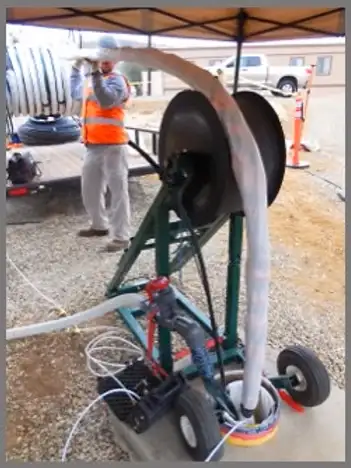
Flute liners are flexible nylon sleeves that seal to the interior of a borehole when pressurized with air, water, or mud. The installation involves pulling the liner off a shipping reel, creating an annular pocket that is lowered inside the casing. Water is added to this pocket to generate pressure for the eversion process, allowing the liner to displace borehole water and seal to the borehole wall.
The Water Flute multilevel groundwater system can be installed in open bedrock wells and multi-screened cased holes in overburden using the eversion process. Installation depends on factors like hole depth, diameter, and water table level. If the borehole is too tight, water can be pumped from beneath the liner using a pre-installed pump tube, which is removed after installation to create a seal.
Once installed, formation water flows into the screen and up the tubing inside the liner, allowing measurement of water levels from the surface. Gas pressure is applied to purge and sample the Water Flute, with large volumes collected (generally 1 gallon per stroke) without aeration, making it ideal for VOC sampling. The Water Flute ensures high-quality discrete groundwater samples directly from the formation.
Water Flute Pump System
(single port system shown for clarity)
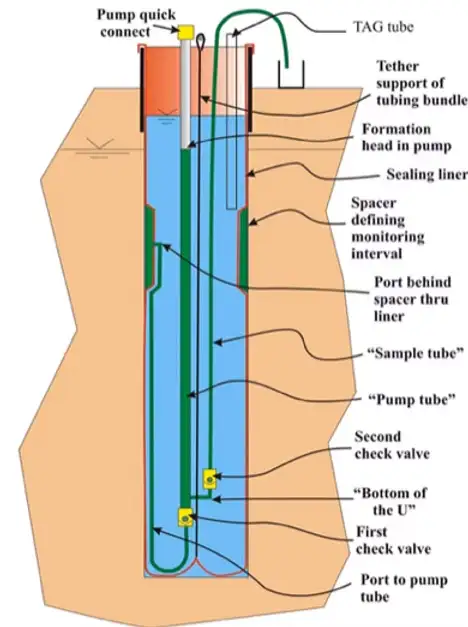
Water Flute Pumping System
How Can You Use the Water Flute?
Conduct multilevel water sampling and level monitoring in unconsolidated soils or bedrock
- Identify and assess both vertical and horizontal contaminant distribution
- Define groundwater flow patterns
- Perform 3D site characterizations
- Develop an early warning system for detecting migrating contaminants
- Monitor the performance of natural attenuation or remediation processes
- Track VOCs, MTBE, and perchlorate at NAPL sites
- Optimize the design and performance assessment of remedial options
Related Products
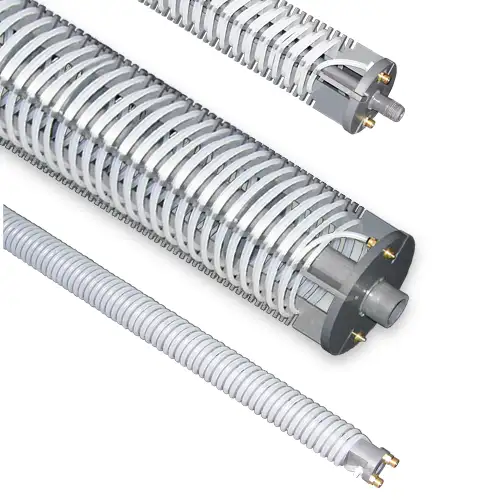
Enhanced Bioremediation
The Waterloo Emitter™is a simple, low cost device designed for the bioremediation of contaminated groundwater. It enables oxygen or other amendments to diffuse through silicone or LDPE tubing in a controlled, uniform manner. Ideal for aerobic bioremediation of MTBE and BTEX, with minimal maintenance required.
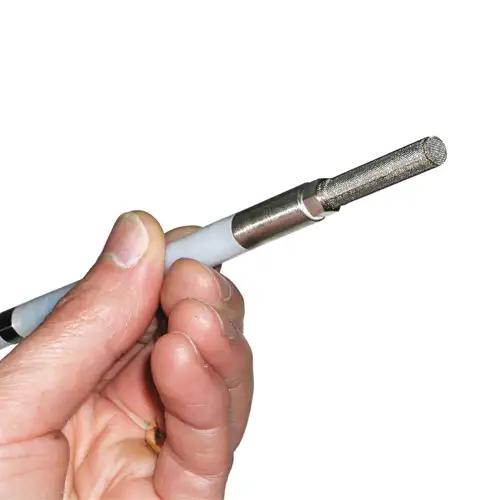
3/8" Diameter Flexible Pneumatic Pump
The Micro Double Valve Pump has a remarkably small and flexible design. At 3/8" (10 mm) diameter it is small enough to sample groundwater from channels of a CMT System.
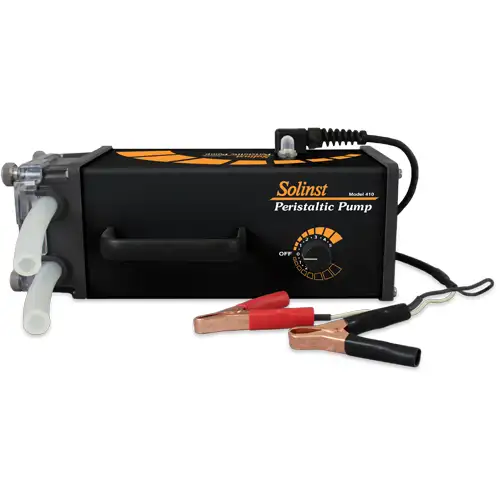
Rugged Peristaltic Pump
Compact, lightweight, and water-resistant, the Solinst Peristaltic Pump is designed for field use. One easy-access control allows various speeds and reversible flow. Ideal for shallow water and vapor sampling.
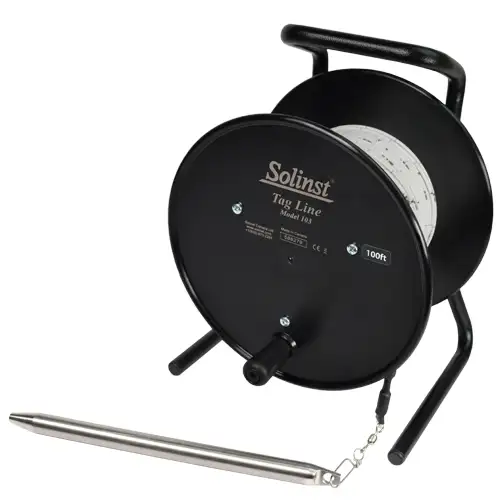
Tag Line - Rugged, Simple, Convenient
The Tag Line uses a weight attached to laser marked cable, mounted on a sturdy reel. Convenient for measuring depths during monitoring well construction.


