
Blank Liner FAQ: Frequently Asked Questions

Solinst Flute Blank Liner Frequently Asked Questions: FAQs
Who can install blank sealing liners?
Almost anyone can install Solinst Flute Blank Liners. We provide a free 50 minute video teaching the blank liner installation and removal procedure. Otherwise, Solinst Flute can install them for labor and travel expenses.
What are the deepest blank liner installations?
1400 feet is the deepest installation to date, but a much deeper installation is in planning.
What are the borehole diameters that can be sealed with a blank liner?
Possibly as small as 2 inch diameter, under the proper circumstances, other wise 3 inch to greater than 20 inches. The smallest liner everted by Solinst Flute was ¾ inch.
Will a blank liner seal a washout?
Not if the washout has an actual circumference (irregularities included) larger than the liner circumference. However, the liner will seal the hole above and below the washout.
How long does it take to install or remove a blank liner?
One to two hours typically, regardless of hole depth. Some are much faster. If the liner was installed extra deeply at high head for many hours, the removal will be proportionately longer.
Are blank liners difficult to remove?
No, not if correctly installed. Early users of blank liners installed them more deeply than necessary to seal the hole. See when to stop installing a blank liner for an explanation of how deeply the blank liner should be installed. It is also much easier with the proper equipment (a Solinst Flute “green machine”). It is not necessary to remove the water from beneath the liner as it is installed.
Does it make any difference if the wellhead surface casing is above or below the surface (e.g., in a vault)?
No, but the vault must be sufficiently large to allow the liner to be connected to the casing. Special adapters are available if needed. If a Water Flute is to be installed later, the minimum vault dimensions needed are provided in Water Flute vault dimensions.
What equipment is required to install a blank liner?
A wellhead roller may be useful for the installation, but the removal usually requires a wellhead roller and hand winch. Several versions are available. Those are available for rental.
Can I use a vehicle to pull a blank liner out of the hole?
Not without a high risk of damage to the liner and the risk of it becoming stuck in the hole.
Can one use a lift cable on a drill rig to remove a blank liner?
No However if the tension on the liner is continuously measured and within the guidelines available (liner tension limits), a lift cable system can be used.
Are blank liners reusable?
In the same hole, yes. In another hole, yes, if cross contamination is not a concern.
Can blank liners be decontaminated?
Decontamination is not practical. The labor expense, water disposal, and certification that they are clean are more expensive than the price of a new liner.
Can one install a 6 inch liner in a 4 inch hole?
Not usually, but a 6 inch liner can be installed in a 5 inch diameter hole.
Does the casing and liner need to be the same size?
No. A 4 inch liner is often installed through a larger casing. Some installations have been done through a smaller casing into a larger hole below the casing. It depends upon the casing size in that case. Generally, it is better if the surface casing size is near that of the borehole diameter.
Can the liner seal a rough or noncircular hole?
A video is available upon request of the inside of a liner in a very rough borehole (vugs, fractures and enlargements). The liner appears to be “painted” on the borehole wall. It conforms very well to the rugosities.
Can Blank Liners be installed in karst formations?
Yes, in most cases. It is a common practice. Sometimes an eversion aid is needed to pass through a large cavern.
What is meant by a 210 denier nylon?
Denier is a measure of yarn weight per specific length. Low values generally produce more finely woven fabrics and of lesser strength. A 210 denier high quality nylon fabric has a tensile strength of about 150 lb/inch. Our 400denier has about a 200 lb/inch tensile strength. 840 denier is 300-400lb/inch. The higher denier are more coarse, more stiff and not suited for small well diameters (<6 inches) in most cases. Solinst Flute uses exceptionally high quality coated nylon and polyester coated fabrics.
What is a single coated fabric?
Our single coated fabric liners are urethane coated on one side and essentially impermeable (urethane is the toughest of the various coatings available). Double coated fabrics are coated on both sides and are more expensive. Blank liners are usually single coated since most are temporary liners. Water Flutes use a double coated fabric.
What is the tether?
The “tether” is a rope connected to the inside, bottom end of the liner. It is the same length as the liner. The standard blank liner tether is a 4000lb test, 3/16 inch woven, Spectron cord with special properties for its application. The tether is used to lower the liner into position and for its removal.
Do blank liners ever leak?
Sometimes. Solinst Flute Blank Liners are tested to be essentially air tight. However, if dragged on pavement or damaged by logging tools or other devices lowered inside the liner without sufficient precautions, the coating can be damaged to cause a slow leak. If the effective excess head inside the liner exceeds 100 ft, the liner may be ruptured in any unsupported (enlarged) portion of the hole. A sharp object in the borehole can puncture a liner (e.g., a rusted pipe section). However relatively few liners leak. Solinst Flute will remove and replace any liner leaking due to manufacturing or material defects at no cost.
Can anyone perform a Flute transmissivity profile with a blank liner?
Only Solinst Flute, or a licensed operator, has the expertise and the equipment to perform the transmissivity measurement.
Can anyone perform a Solinst Flute reverse head profile with a blank liner?
So far, only Solinst Flute has performed a reverse head profile and usually immediately after a transmissivity profile.
Related Products
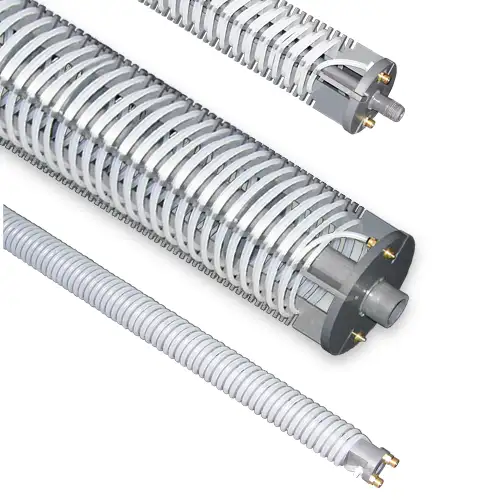
Enhanced Bioremediation
The Waterloo Emitter™is a simple, low cost device designed for the bioremediation of contaminated groundwater. It enables oxygen or other amendments to diffuse through silicone or LDPE tubing in a controlled, uniform manner. Ideal for aerobic bioremediation of MTBE and BTEX, with minimal maintenance required.
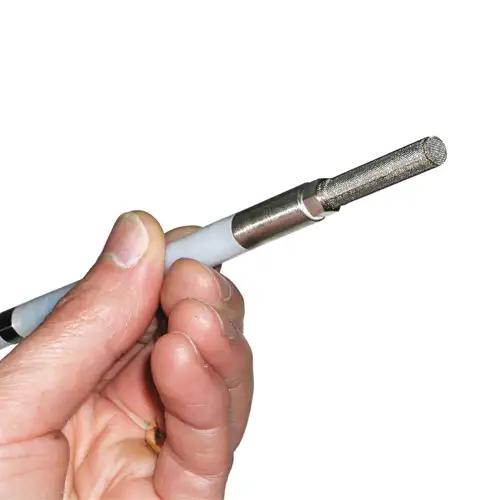
3/8" Diameter Flexible Pneumatic Pump
The Micro Double Valve Pump has a remarkably small and flexible design. At 3/8" (10 mm) diameter it is small enough to sample groundwater from channels of a CMT System.
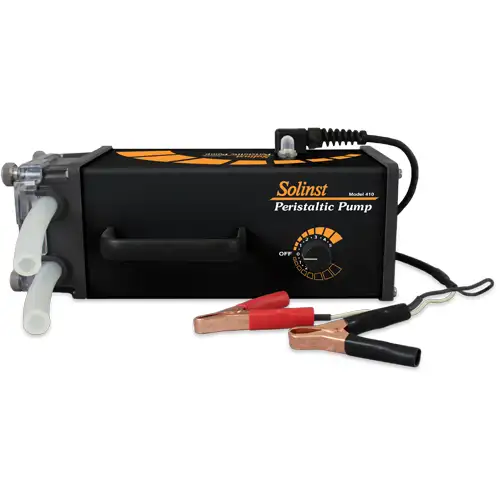
Rugged Peristaltic Pump
Compact, lightweight, and water-resistant, the Solinst Peristaltic Pump is designed for field use. One easy-access control allows various speeds and reversible flow. Ideal for shallow water and vapor sampling.
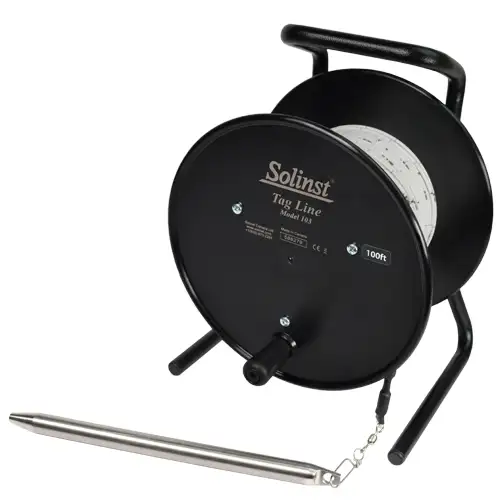
Tag Line - Rugged, Simple, Convenient
The Tag Line uses a weight attached to laser marked cable, mounted on a sturdy reel. Convenient for measuring depths during monitoring well construction.


