
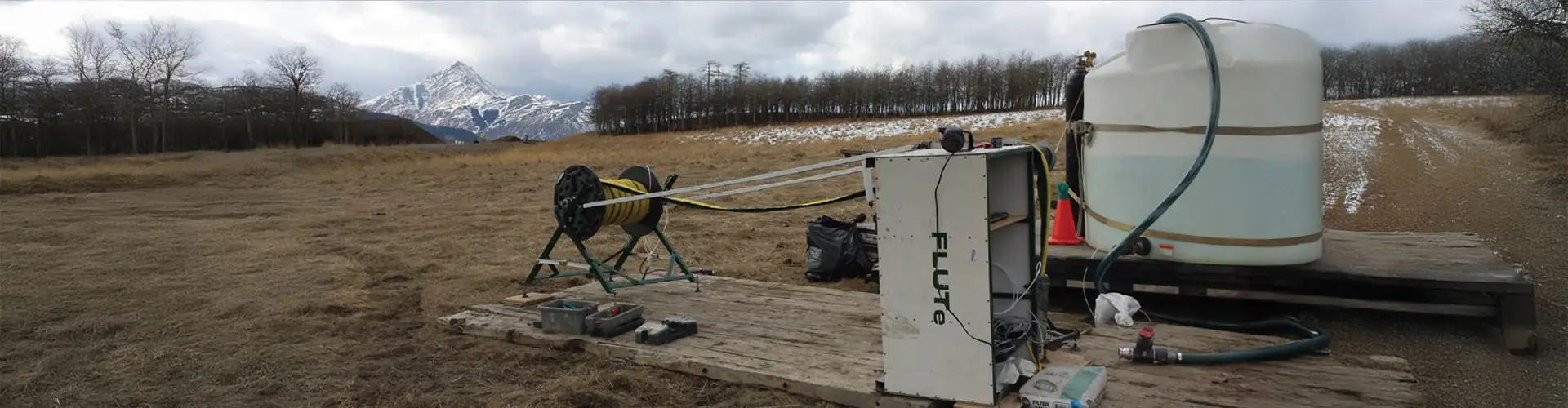
Model 405 Reverse Head Profile


Map Vertical Flow Dynamics with the Solinst Flute Reverse Head Profile
Stop Guessing. Start Measuring. Identify vertical hydraulic gradients and cross-flow potential in a single day.
When characterising fractured bedrock or complex aquifers, knowing where the water is moving is only half the battle. You need to know the driving force behind that movement. The Solinst Flute Reverse Head Profile (RHP) provides a high-resolution map of vertical hydraulic head distribution, allowing you to identify the potential for cross-contamination before it compromises your site.
How does the Reverse Head Profile work?
The method involves the inversion (removal) of the blank liner in a stepwise fashion after the completion of a Transmissivity Profile. The blank liner is stopped between flow zones of interest as identified by the transmissivity profile.
As the blank liner is inverted from the well, it uncovers discrete borehole intervals of interest that were sealed during the transmissivity profile. A pressure transducer located beneath the liner in the borehole records the new steady state borehole equilibrium pressure, Bhi, after each interval is uncovered. As we already know the transmissivity of each interval and the previous steady state borehole equilibrium pressure, we can calculate the contribution of the newly uncovered borehole interval by using each new “blended head” beneath the liner and writing the flow equations for each increment that has been uncovered.
We define the net flow into and out of the hole to be zero, and using the transmissivity, Ti, measured for each increment in the hole, one has only the formation head, FH as an unknown for each newly exposed interval of the hole.
Unlike traditional packer testing that can take days and often suffers from bypass leakage, the Reverse Head Profile uses the continuous seal of a Flute Blank Liner to isolate and measure discrete zones with surgical precision—all within a standard work day.
Key Benefits for Your Site Characterization
- Prevent Cross-Contamination: Identify vertical gradients that could drive contaminants into clean zones if the borehole is left open.
- Rapid Data Collection: Capture discrete-zone head measurements for an entire borehole typically in less than 8 hours.
- High-Resolution Insights: Move beyond “blended” water levels to see the true pressure distribution across different geological units.
- Optimize Multi-Level Design: Use the RHP data to perfectly place sampling ports for permanent systems like the Water Flute.
- Cost-Effective Alternative: Eliminate the heavy equipment and long durations required for traditional nested wells or extensive packer assemblies.
Features of the Model 405 Reverse Head Profile
- Stepwise Inversion Technology: A controlled, stepwise removal of the Blank Liner that systematically uncovers flow paths for individual head calculation.
- Real-Time Equilibrium Tracking: Utilizes a high-accuracy pressure transducer at the bottom of the borehole to verify steady-state head measurements.
- Integration with Transmissivity Data: Combines your flow-path mapping with pressure data to build a complete 3D conceptual site model (CSM).
- Versatile Application: Effective in boreholes up to 1000 ft (300 m) deep and across various diameters.
- Removable & Non-Permanent: Provides the data of a multi-level system without the commitment of a permanent installation.
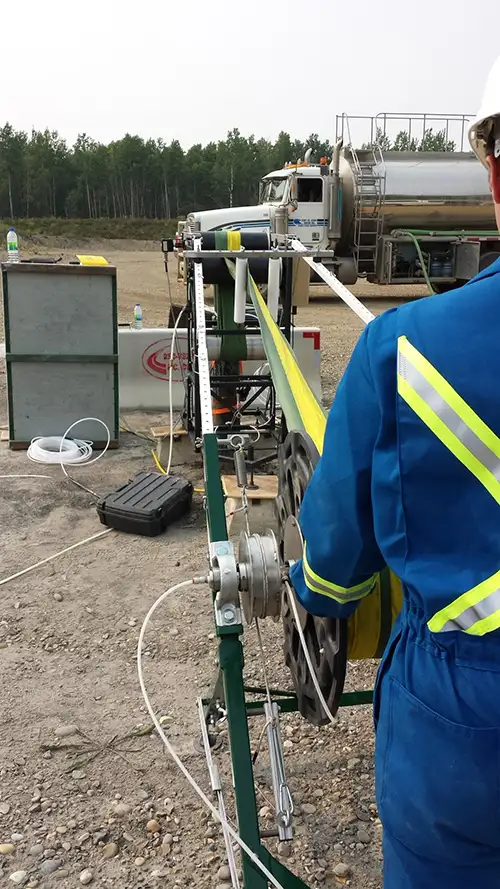
How It Works: The Path to Better Data
The Reverse Head Profile is the “second act” of the Solinst Flute profiling process. After the initial installation (eversion) maps the Transmissivity, the liner is removed (inverted) in steps. As each new interval is uncovered, the blended head beneath the liner shifts. By tracking these shifts and applying the known transmissivity values, we calculate the unique formation head for every significant zone in your borehole.
Related Products
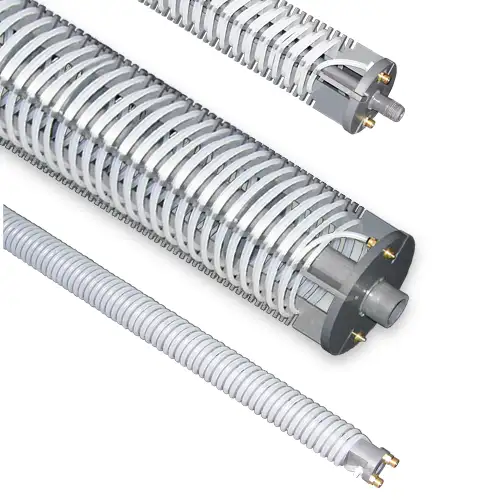
Enhanced Bioremediation
The Waterloo Emitter™is a simple, low cost device designed for the bioremediation of contaminated groundwater. It enables oxygen or other amendments to diffuse through silicone or LDPE tubing in a controlled, uniform manner. Ideal for aerobic bioremediation of MTBE and BTEX, with minimal maintenance required.
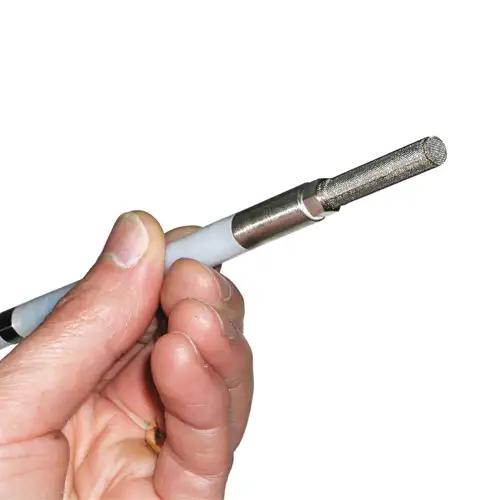
3/8" Diameter Flexible Pneumatic Pump
The Micro Double Valve Pump has a remarkably small and flexible design. At 3/8" (10 mm) diameter it is small enough to sample groundwater from channels of a CMT System.
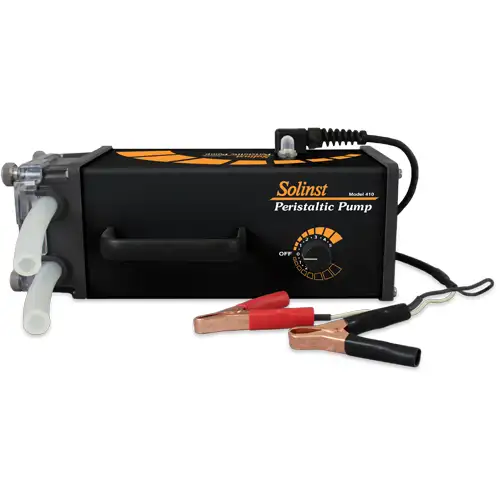
Rugged Peristaltic Pump
Compact, lightweight, and water-resistant, the Solinst Peristaltic Pump is designed for field use. One easy-access control allows various speeds and reversible flow. Ideal for shallow water and vapor sampling.
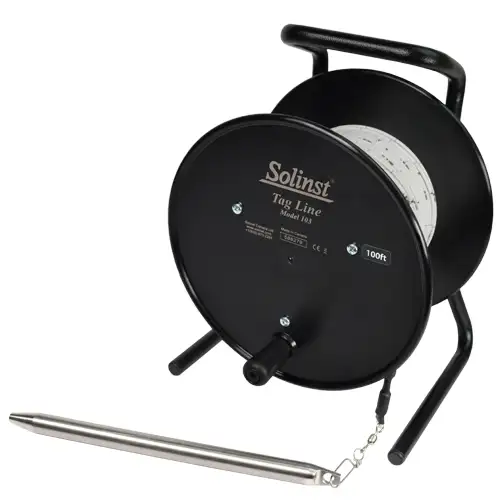
Tag Line - Rugged, Simple, Convenient
The Tag Line uses a weight attached to laser marked cable, mounted on a sturdy reel. Convenient for measuring depths during monitoring well construction.


