
405 FACT: Flute Activated Carbon Technique Datasheet


FACT – Flute Activated Carbon Technique
Model 405
FACT is an innovative method developed for mapping the dissolved phase contaminant distribution in a sealed borehole, with 6 inch to 3 feet (15 cm to 1 m) resolution.
A common practice is to combine the FACT with the NAPL Flute cover to locate both the non-aqueous and the dissolved phase. The NAPL Flute system is a reactive cover for the Solinst Flute Blank Liner.
The Solinst Flute Blank Liner is a fully removable solution designed to seal open boreholes to prevent cross-contamination.
For more information on Solinst Flute Blank Liners and the NAPL Flute and their installation, see the Model 405 Blank Liner and NAPL Flute Data Sheets.
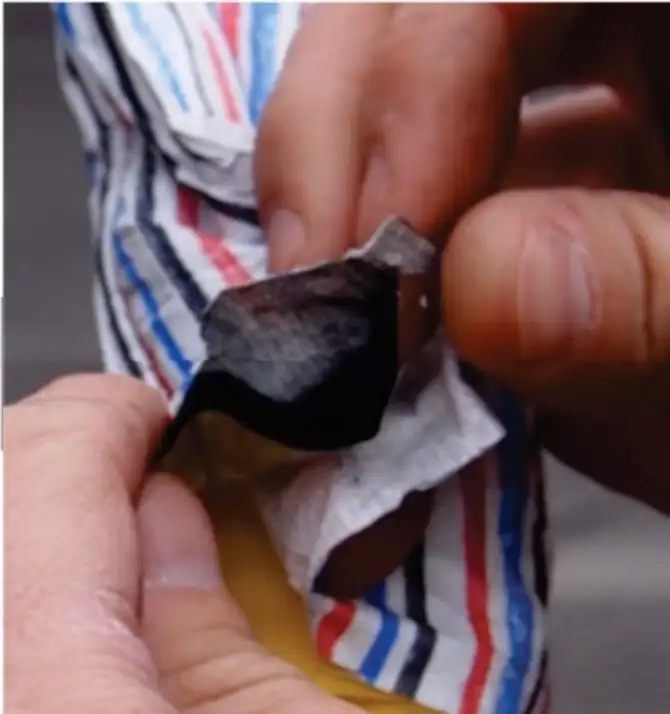
FACT Construction, with the FACT stitched between the NAPL Flute cover (striped) and a diffusion barrier (silver)
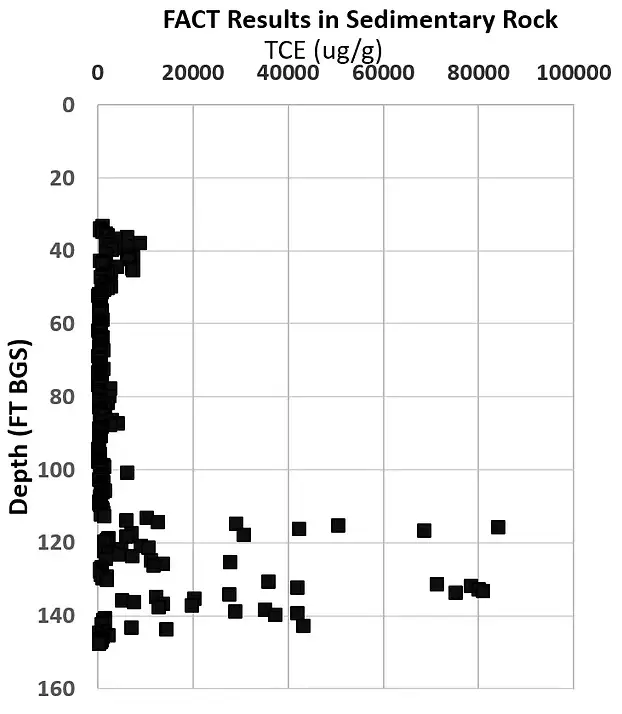
FACT resutls for TCE on a 6 inch scale
How the Flute Activated Carbon Technique Works
The Flute Activated Carbon Technique involves the use of a 1.5″ (3.8 cm) continuous strip of activated carbon felt that is added to the NAPL Flute. The activated carbon felt is emplaced against the borehole wall during the eversion of a Blank Liner, or installation through direct push rods for overburden applications.
Once positioned against the borehole wall, the activated carbon felt wicks away the contaminants in pore spaces and fracture flows by diffusion. As the diffusion process takes place in a sealed borehole, the concentrations recorded during the technique are not influenced by cross contamination and/or leakage issues. The pressure exerted by the Blank Liner on the borehole wall (generally 5 to 10 feet (1.5 m to 3 m) of water pressure) creates a strong seal which prevents preferential flows from developing.
Concerns of influence by contact with borehole water are put to rest by the protection provided by the hydrophobic NAPL Flute cover and speedy installation and removal procedures, which minimize interval exposure times to a few seconds. As a precaution, the borehole water is usually pumped from the hole as the Blank Liner is everted.
After two weeks, the FACT installation is removed from the well, cut into the desired sample intervals (6 inches to 3 feet (15 cm to 1 m)) and sent to the lab for analysis (EPA 8265).
FACT Installation
Installation Times
Solinst Flute Blank Liner systems should be installed as quickly as possible after the hole is drilled to minimize cross connection effects of the borehole water on the pore water in the open borehole.
Reaction Times
Vadose Zone
The FACT is typically left in place for 48 hours for a vadose zone installation to allow the diffusion process from the formation into the carbon.
Saturated Zone
The FACT should be left in place in the saturated zone for about two weeks due to the diffusion coefficient being much smaller in water than in air. A diffusion calculation shows that two days is long enough to “see” about 0.5 cm into the borehole wall with 7% porosity. Concentration in pores is 2,700 ug/L. That improves after two weeks.
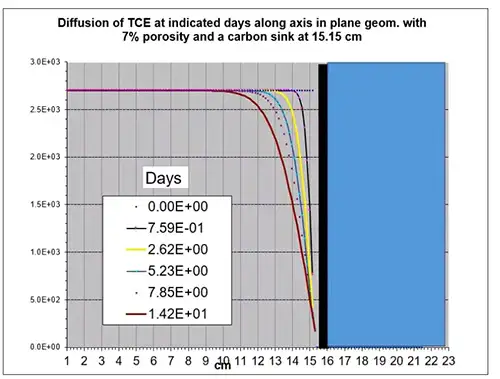
Academic Analysis of the FACT
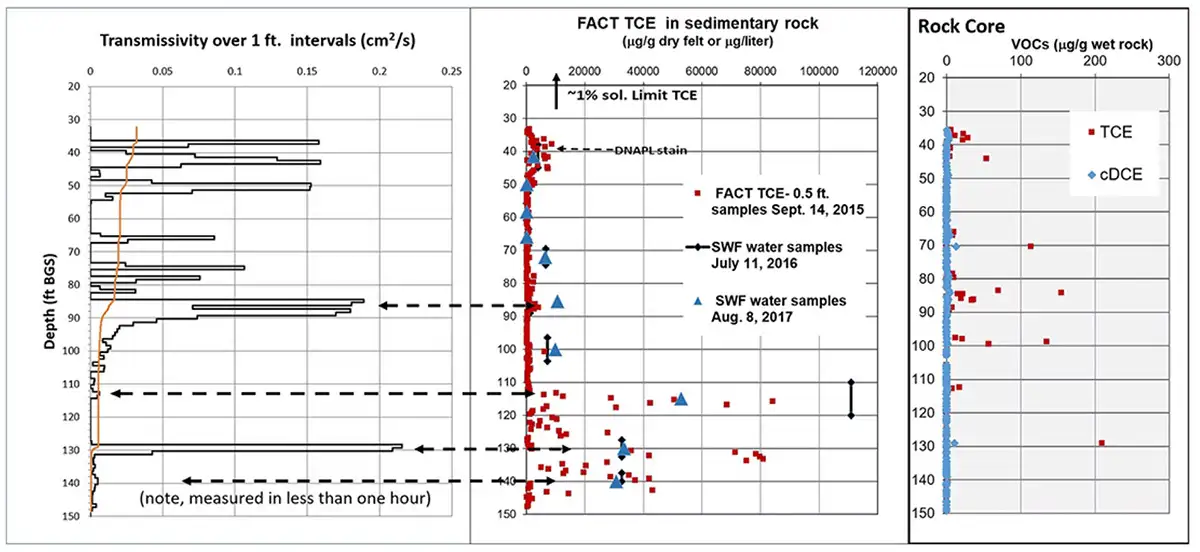
FACT Method Results
Related Products
Enhanced Bioremediation
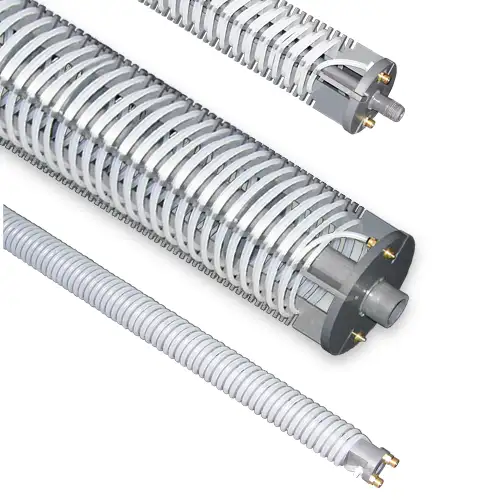
The Waterloo Emitter™is a simple, low cost device designed for the bioremediation of contaminated groundwater. It enables oxygen or other amendments to diffuse through silicone or LDPE tubing in a controlled, uniform manner. Ideal for aerobic bioremediation of MTBE and BTEX, with minimal maintenance required.
3/8" Diameter Flexible Pneumatic Pump
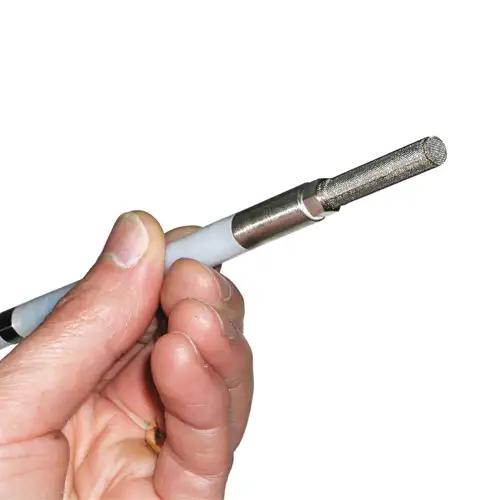
The Micro Double Valve Pump has a remarkably small and flexible design. At 3/8" (10 mm) diameter it is small enough to sample groundwater from channels of a CMT System.
Rugged Peristaltic Pump
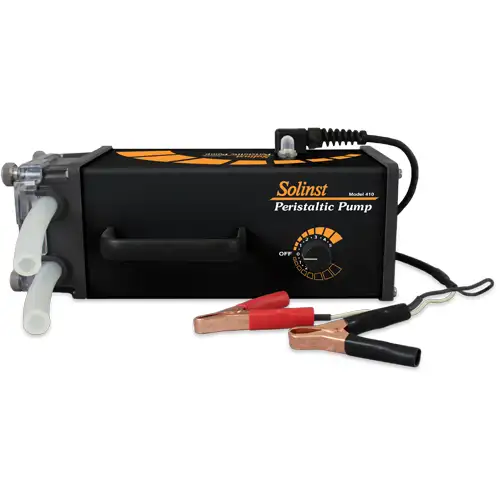
Compact, lightweight, and water-resistant, the Solinst Peristaltic Pump is designed for field use. One easy-access control allows various speeds and reversible flow. Ideal for shallow water and vapor sampling.
Tag Line - Rugged, Simple, Convenient
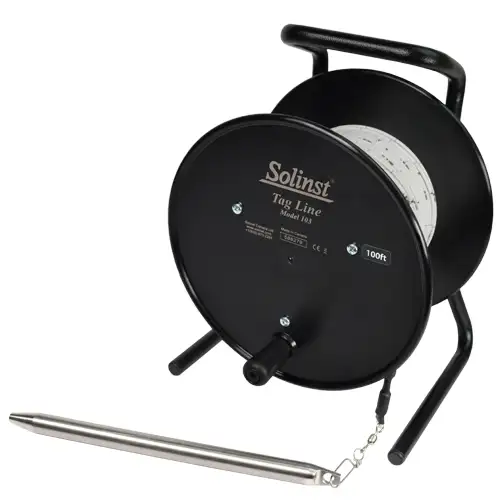
The Tag Line uses a weight attached to laser marked cable, mounted on a sturdy reel. Convenient for measuring depths during monitoring well construction.


