
CMT Vapour Monitoring
Background
The vast majority of CMT applications are used for the sampling and monitoring of groundwater. However, CMT systems can also be used to sample contaminant vapour concentrations in the unsaturated or vadose zone above the water table.
Not all contaminants produce significant vapour to make vadose zone monitoring worthwhile. Appropriate contaminants are those characterised by high vapour pressures and include components of petrol (e.g. BTEX); chlorinated solvents such as trichloroethylene (e.g. TCE) and their breakdown products (e.g. vinyl chloride and methane). These vapours can be hazardous due to their potential to explode, as in the case of BTEX and methane, or due to their general toxicity when inhaled (vinyl chloride, benzene).
Depth-discrete vapour sampling is also necessary to accurately assess the potential risks to above-ground receptors resulting from vapour migration. Such assessments are now an essential component of environmental investigations performed at contaminated sites undergoing redevelopment (i.e. brownfield sites).
CMT System
The CMT system can be easily modified to accommodate vapour monitoring in one or more channels. For example, the system could be configured so that some of the channels sample vapour from the vadose zone; or all of the channels can be dedicated to soil vapour monitoring.
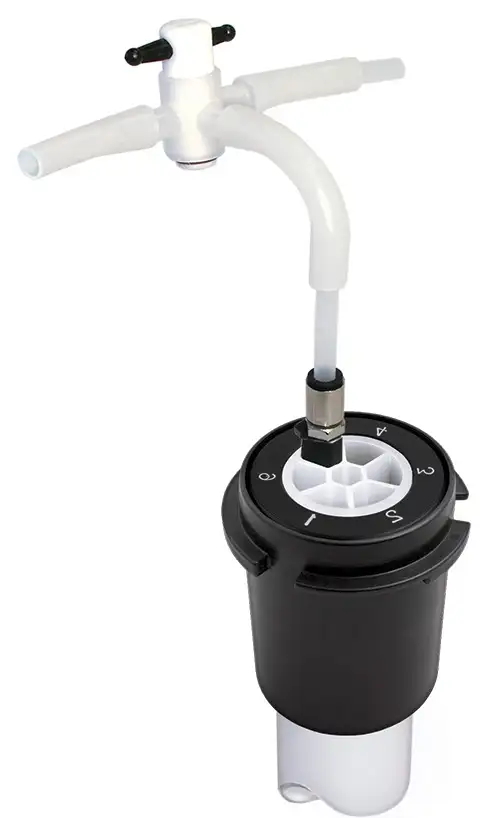
During vapour sampling, the CMT is constructed in the same manner as for groundwater sampling, except that each vapour sampling channel is fitted with a special flow-through seal assembly which is inserted at the top of the channel.
Vapour Wellhead
Assembly Model 403
A channel seal assembly allows attachment of a three-way valve to direct vapour to a pressure gauge connected at one end of the valve and a sample vessel at the other.
Images courtesy of Waterra (UK) Limited
Data courtesy of Paul Sojka, Pollution Control Manager, Worcestershire County Council, UK
Vapour Sampling Considerations
Vapours have the potential to diffuse rapidly through some materials including polyethylene from which the CMT is constructed. In order to limit the adverse effects of diffusion through the outer CMT channel wall or the inner chambers it is recommended that a protocol be developed that ensures a representative sample is obtained directly from the port intake area.
It is very important to thoroughly purge any gas present in the channel of the system, followed by field screening of vapour concentrations until readings stabilise. Sampling should immediately follow after purging and stabilisation. It is also advisable to maintain a steady flow of vapour through the system and draw a sample without stopping the flow, to minimise any sample bias attributable to diffusion through the tubing walls.
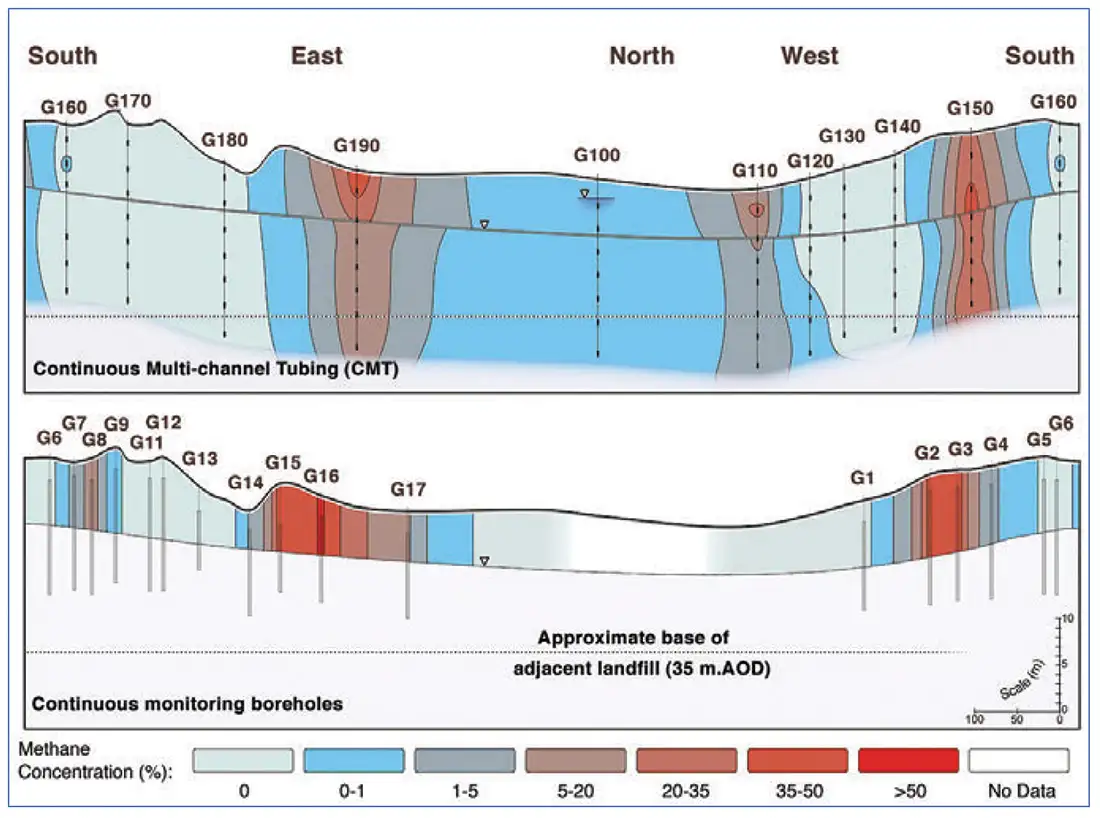
Concentrations of methane in both the vapour phase and dissolved phase collected from CMT systems are shown in the upper diagram. The lower diagram plots methane vapour concentrations taken from long screened wells.
Reference: Electrical Power Research Institute (EPRI), 2005. Reference Handbook for Site-Specific Assessment of Subsurface Vapour Intrusion to Indoor Air. Document#1008492. Published by EPRI, California.


