
CMT for High Resolution Vapour Intrusion Monitoring
Background
Vapour intrusion refers to the movement of volatile chemicals from the subsurface into the indoor air of overlying buildings. The most common source is groundwater or soil contaminated with volatile organic compounds (VOCs). VOCs emit vapours that migrate into pore spaces of the soil and upward into the overlying environment.
Generally, vapours enter buildings through cracks and openings in the foundations because of a difference between interior and exterior pressures. Pressure differences occur due to many factors, including barometric fluctuations, wind load, thermal currents, and depressurisation from exhaust fans and ventilation or heating systems in buildings.
Chemicals such as BTEX and TCE break down and produce vapours, that if accumulated to high levels, can pose short-term safety concerns such as explosions; chemicals such as benzene and vinyl chloride are toxic when inhaled. More often, vapour concentrations are present at low levels; this can cause chronic health effects if exposure to them is long-term.
Vapour intrusion monitoring and soil vapour sampling is essential for risk assessments, especially at Brownfield redevelopment sites, to determine the potential exposure and risk to above-ground receptors.
CMT Multilevel System
Solinst CMT Multilevel Systems provide a quick and cost-effective way to delineate soil gas concentrations below buildings. To allow discrete profiling, the system is easily modified to accommodate vapour monitoring in one or more channels. It is constructed in the same manner as for groundwater sampling, except that each vapour-sampling channel is fitted with a special seal assembly, which is inserted at the wellhead.
A channel seal assembly allows attachment of a three-way valve to direct vapour to a pressure gauge connected at one end of the valve and a sample vessel at the other. A vacuum pump can be used to draw samples from each discrete zone.
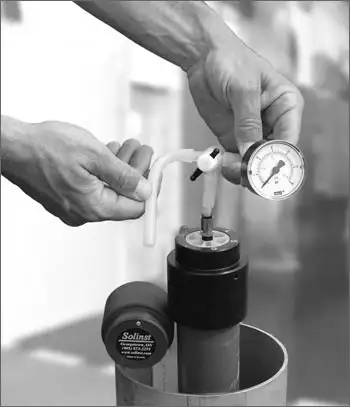
7-Channel CMT fitted with a three-way valve used for vapour sampling.
The CMT can be used for sub-slab vapour sampling (immediately beneath the building) or near-slab vapour sampling (typically within 10 ft or 3 m of the building).
Near-slab sampling is primarily performed to identify underground contamination and the potential source, extent and movement of the pollutants. Sub-slab vapour samples are used together with indoor air and outdoor air samples to determine any current human exposure, potential for future exposure and site-specific attenuation factors.
The multiple channels in the CMT allow sampling at discrete depths, and allow groundwater data to be collected simultaneously, if required for comparison. The result is defensible data, which allows more detailed site characterisations and more accurate risk assessments, enabling increased confidence in decision-making.
Sampling Considerations
Vapours have the potential to diffuse through some materials, including polyethylene from which the CMT is constructed. In order to limit the adverse effects of diffusion it is recommended that a protocol be developed that ensures a sample is obtained directly from the CMT port intake.
Purging any gas present in the CMT is crucial, followed by field screening of vapour concentrations until readings stabilise; it is recommended that sampling follow immediately after. Maintaining a steady flow of vapour through the system while sampling is advisable.
References
ITRC (Interstate Technology & Regulatory Council). 2007. Vapour Intrusion Pathway: A Practical Guideline. VI-1. Washington, D.C.: Interstate Technology & Regulatory Council, Vapour Intrusion Team. www.itrcweb.org.
USEPA. 2002. Draft Guidance for Evaluating the Vapour Intrusion to Indoor Air Pathway from Groundwater and Soils. Washington, D.C.: Office of Solid Waste and Emergency Response. www.epa.gov/correctiveaction/eis/vapor/complete.pdf
Solinst Sampling Options
Solinst offers other instruments ideal for vapour sampling. Model 615 Drive-Point Piezometers can be used as temporary wells to sample soil gas. A compression fitting allows the attachment of 1/4” sample tubing directly to the top of the screened portion of the drive-point. Model 410 Peristaltic Pumps allow vapour sampling from shallow depths.
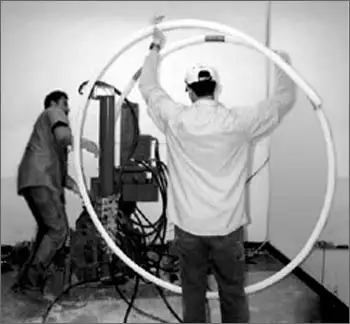
7-Channel CMT installation for monitoring groundwater and soil gas beneath a building.


