Model 403 CMT Multilevel System
Advantages of Multilevel Systems
- Provides the most accurate 3-D assessment of a site
- Vital to understanding vertical flow of contaminants
- Allow documentation of changes in the concentration and delineation of a contaminant plume
- Low cost compared with multiple individual wells
Research has shown that contaminant plumes are often thin and highly stratified. Traditional monitoring wells, with screened intervals of 10 ft. (3 m) or more, blend the groundwater over the entire length of the screen. This can mask the true concentrations and distribution of contaminants. Multilevel wells with short screened intervals overcome this problem and offer more precise identification, better design options for treatment and ongoing monitoring.
CMT Multilevel System
This reliable easy to install and inexpensive multilevel system provides site assessors with a better understanding of the three-dimensional groundwater flow and distribution of contaminants. Remediation strategies can then be targeted more precisely, focusing efforts in the most effective manner.
The CMT Multilevel System makes the accurate monitoring of contaminant plumes much more affordable. It provides detailed vertical as well as horizontal data. The simple 1.7 (43 mm) OD polyethylene tube is segmented into 7 channels, allowing groundwater monitoring at up to 7 depth-discrete zones. Monitoring zones are set where needed and the single tube design allows reliable seals between zones.
Applications
- Ideal for shallow wells in high water table
- Multilevel water sampling and level monitoring in unconsolidated soils, bedrock or screened wells
- Monitoring of natural attenuation or remediation processes
- Identify vertical as well as horizontal contaminant distribution with transect monitoring
- NAPL, VOC and MTBE Monitoring
- Mass transport calculations and mass flux estimation
- Determination of the best location for reactive barrier walls
Endorsements
Our initial assessment of the CMT system is that, it is performing as expected and we are pleased with the capability it provides..... Really great innovation, characterizes core of plume with far fewer wells.
|
|
Fred Kintzer, Principal Geologist,Project Manager
Parsons Engineering Science Inc.
|
|
We used CMT to monitor groundwater down gradient of an ORC barrier wall in a pilot study at a Superfund site....Our results showed that the CMT and packers performed as expected, isolating each sampling zone. Use of the CMT was an excellent idea.
|
|
Brian Butler,
Senior Geologist,
Harding ESE
|
|
On a chlorinated solvent site, it was extremely useful as a site characterization tool to better map contaminant's in 3D .... allowed targeting of remediation efforts.
|
|
Tim Buscheck,
Senior Staff Hydrogeologist,
ChevronTexaco
|
|
Multichannel Tubing
A multilevel well that uses a continuous length of multichannel tubing has the advantage over other multilevels in that there are no joints. This significantly reduces the time and cost of installing wells and at the same time increases the reliability of the system. The CMT tubing is very simple and convenient to use, as it gives full flexibility as to where monitoring zones are located. Also a single coil of tubing can be used for a number of well installations.
The tubing has a ridge down its entire length to allow for easy identification of specific channels. Ports and packers can be assembled in the field, immediately after drilling the borehole, to reduce open hole time and potential cross-contamination between zones.
Ports
The number and location of ports may be determined in advance, or after drilling the borehole. A Port Cutting Guide is used to cut 2 holes in a vertical line into a given channel, at the specified depth for each zone to be monitored. The plastic between the holes is cut out leaving an opening suitable for inserting a plug, as illustrated above. The plug is positioned and sealed in the channel just below the channel opening.
A vent hole is also placed just below the plug to allow air to escape as the system is lowered into the borehole. This allows water from the monitoring zone to fill the channel below the zone to overcome buoyancy. A stainless steel screen is fixed in place over the port to prevent fines from entering. The screen kits come in a variety of mesh sizes, complete with clamps and plugs. Each channel is sealed at the bottom of the tubing to avoid cross contamination between monitoring zones.
Double-Acting Packers
Double-Acting Packers are ideal for use in situations where a CMT System is in a cased or screened well, or in a smooth rock borehole, and when removal of the system for decommissioning or reuse is important. The Double-Acting Packers have both an inner and an outer gland to seal against the CMT tubing and the borehole. The packers are hydraulically inflated allowing easy removal.
Advantages of the CMT Multilevel
- Low cost and ease of use
- Up to 7 depth-discreet zones in a single tube
- No joints: one smooth surface for easy, effective sealing
- Locate ports and packers anywhere along the tubing
- Installations completed using alternate sand and bentonite layers are reliable and inexpensive
- Double-Acting Packers allow easy system removal
- Simple system usually customized and built on site
- The hole is not left open to allow cross contamination
- Installs quickly in large direct-push casing and bigger holes
- One 7-zone CMT System can be completed by two people in under 3 hours.
- Minimizes the risk of producing new contaminant pathways.
Monitoring your CMT Multilevel
Water levels and samples can be accurately obtained using the following quality Solinst instruments:
Level: The Mini 101 Water Level Meter is excellent for shallow CMT Systems, in lengths of 30ft, 65ft, 10m or 20m. The narrow 1/4 (6 mm) tape is mounted on a convenient small reel. A narrower coaxial cable Model 102 Water Level Meter may be easier for use in deeper CMT Systems. The 3/8 dia. (10 mm) Druck Pressure Transducer can be used with a data logger for continuous level monitoring.
Sampling:
The Solinst Model 410 Peristaltic Pump which has a suction lift limit of approximately 25 ft (7.5 m).
Model 103 Tag Line
The Model 103 Tagline is ideal for accurate placement of sand and bentonite during borehole completion.
Drilling Methods and Techniques for Installing
CMT Wells in Unconsolidated Aquifers
| Drilling Method |
Advantages |
Preferred CMT Installation Technique |
Comments |
| Sonic |
Casing advance during drilling minimizes redistribution of contaminant's in borehole. Steel casing prevents borehole from collapsing as CMT well is being built. Vibration of the casing during removal reduces likelihood of bridging annular materials.
|
Place CMT tubing into casing with anchor plate attached to bottom of tubing. Use tubing centralizers to center tubing inside sonic casing. Add alternating lifts of sand and bentonite pellets as casing is withdrawn using either gravity placement, tremie methods.
|
Depths up to 300 feet. Use casing with an inside diameter (ID) of at least 4 inches (100 mm). Addition of water to casing may be needed to counteract buoyancy and heaving sand as casing is removed.
|
| Hollow Stem Auger (HSA) |
Rigs widely available. Augers provide temporary casing that can be withdrawn as CMT System is constructed.
|
Place CMT tubing with anchor plate into borehole inside of hollow stem augers. Add alternating lifts of bentonite pellets and sand as augers are removed. CMT tubing centralizers may be needed to keep annular space open during well construction.
|
Generally limited to depths of approximately 100 feet. Water may need to be added to augers to counteract heaving sand conditions. Use augers with at least a 4-inch ID.
|
| Direct Push (DP) |
Rigs are widely available.
|
Insert CMT tubing into DP casing, then withdraw casing.
|
Best for shallow installations where sand collapses around CMT tubing. May be difficult to tremie sand and bentonite due to small annular space between CMT tubing and DP casing.
|
| Air Rotary with Casing Advance |
Casing prevents borehole from collapsing as CMT well is being built gives a consistent-diameter borehole. Prevents redistribution of contaminants along borehole wall during drilling.
|
Place CMT tubing into casing with anchor plate. CMT tubing centralizers should be used to center tubing in borehole. Add alternating lifts of sand withdrawn, using either gravity placement, tremie methods.
|
Select casing with at least a
4-inch (100 mm) ID. Addition of water is commonly needed to prevent heaving as casing is removed.
|
| Mud Rotary |
Widely available.
|
Place CMT tubing directly into borehole with anchor plate attached to bottom of tubing. CMT tubing centralizers should be used to center CMT tubing in borehole. Place sand pack and bentonite with a tremie tube and grout pump.
|
Thin drilling fluid as much as possible prior to installing annular materials. Use a coarse-grained filter pack. Mud filter cake can be difficult to remove with development methods available for CMT wells.
|
CMT System Components
The tubing is available in lengths of 100ft, 200ft & 300ft (30m, 60m & 90m). The coils are approximately 4ft. (1.2m) in diameter. If deeper multilevels are desired the Waterloo Multilevel System can be considered. (See Data Sheet 401). CMT tubing is laid out on the ground or plastic sheeting for the preparation of ports, and for placement of packers, when used. The 1.7OD (43mm) CMT tubing has 7 channels. The 6 outer channels are approximately 7/16 ID (11mm) and the smaller central channel is 3/8 (9.5mm). The port screens are held in place using low profile clamps.
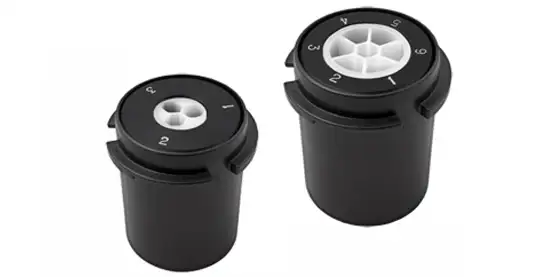
Double-Acting Packers are available in diameters to seal 3 and 4 (75 mm and 100 mm) wells. Centralizers can be used to help position the tubing in the borehole to ensure proper sand and bentonite distribution. The base of the system is completed with a Guide Point Port, which functions both as a point for easier installation and as a seventh port when needed. An optional anchor may be added to prevent the system from lifting during installation. The top of the CMT System is completed with a numbered wellhead that labels each channel for easy identification.
Drilling Contractors
Boart Longyear Company
32 Stokes Drive
P.O. Box 1000
Dayton, NV 89403
Contact: Rob Reedy
Phone: 800-327-7049
Fax: 775-246-3208
email: rreedy@boartlongyear.com
Note: offices throughout U.S.
|
|
Prosonic Corporation
117 Industry Road
Marietta OH 45750
Contact: Steve Bratton
Phone: 614-402-1808
Email: srbratton@msn.com
Note: offices throughout U.S.
|
|
Solinst is seeking Environmental Drillers who are interested in increasing profits by providing their customers with a new and exciting site assessment tool that is easy to install. In one instance, over 47 systems were installed in just 2 days! The popularity of the Solinst CMT Multilevel System is ever increasing. We are pleased to announce that there have been over 1500 CMT installations to date and we are only getting started. This reliable, easy to install and inexpensive multilevel system provides site assessors with a better understanding of the three-dimensional distribution of contaminants. Remediation strategies can then be targeted more precisely, focusing efforts in the most effective manner.
If you are interested in becoming a qualified CMT Multilevel Installer, please click here to fill out the below form and a technical representative from Solinst will contact you.
|
Cascade Drilling
PO Box 1184
Woodinville, WA 98072
Contact: Bruce Niermeyer
Phone: 425-485-8908
Fax: 425 485-4368
email: bniermeyer@cascadedrilling.com
|
|
Resonant Sonic International
220 N. East Street
Woodland, CA 95776
Contact: Derrik Sandberg
Phone: 530-668-2424
Fax: 530-668-2429
Email: derrik@resonantsonic.com
|
|
Gregg Drilling
50 Howe Road
Martinez, California 94553
Contact: Chris Christensen
Phone: 925-313-5800
Fax: 925-313-0302
email: chrisc@ecis.com
|
|
Zebra Environmental Services
503 North Faulkenburg Rd.
Tampa, FL 33619
Contact: Michael Early
Phone: 813 655-1717
Fax: 813 654-9398
email: zebraweb@msn.com
Note: Offices throughout eastern USA
|
|
Precision Sampling, Inc.
1400 S. 50th Street
Richmond, CA 94804
Contact:: Mike Casey
Phone: 800 671-4744
Fax: 510- 237-4574
mike@precisionsampling.com
|
|
Horizon Environmental
Drilling LLC
Rt 1 Box 103
Tryon, OK 74875-9507
Contact: Kari Sever
Phone: 918 375 2507
Fax: 918 375 2707
E-mail: horizon@brightok.net
|
|
|
|
|
Vironex Inc.
1715 E. Wilshire Ave.
Santa Ana, CA 92705
Contact: Todd Hanna
Phn: (714) 647-6290
Fax: (714) 647-6291
E-mail: t.hanna@vironex.com
Note: Offices througout the US
|
|
Solinst Canada Ltd.
35 Todd Rd.
Georgetown, ON
L7G 4R8
Phone: (800) 661-2023; (905) 873-2255
Fax: (905) 873-1992
|